IPv4 Addressing-Part-III
Examples on subnetting Example 1: You have a system address of 196.202.56.0 with five Hosts on each subnet. You need to take into consideration the most extreme …
Continue readingExamples on subnetting Example 1: You have a system address of 196.202.56.0 with five Hosts on each subnet. You need to take into consideration the most extreme …
Continue reading2. VLSM VLSM (Variable Length Subnet Masking) permits productive utilization of IP addresses. Systems actualized with VLSM can be condensed all the more …
Continue reading1. Subnetting (IP4) Subnetting is only making systems inside a system. Subnetting permits an association with a solitary IP address (Class A/ClassB/ClassC) to …
Continue readingTopology is a design of different components of PC organize, for example, hubs, joints, switches, and so on. It is a system topological structure which can be …
Continue readingThe edges for both TCP and UDP are as given underneath: TCP Frame: TCP outline fields: Total 20 bytes in length. 1. Arrangement Number 2. AcK number 3. …
Continue readingTCP/IP Model The TCP/IP demonstrate was made in the 1970s by the Defense Advanced Research Project Agency (DARPA). As the OSI demonstrate, it depicts general …
Continue reading1. OSI and DoD Models 1.2 DOD Model and it’s capacity DOD Model maps to OSI demonstrate as beneath: IP is the convention that works at the Internet layer. It …
Continue readingCollisions, Collision Domains, and Congestion Another issue with Ethernet is again caused by CSMA/CD: the more devices you put on a segment, the more likely …
Continue reading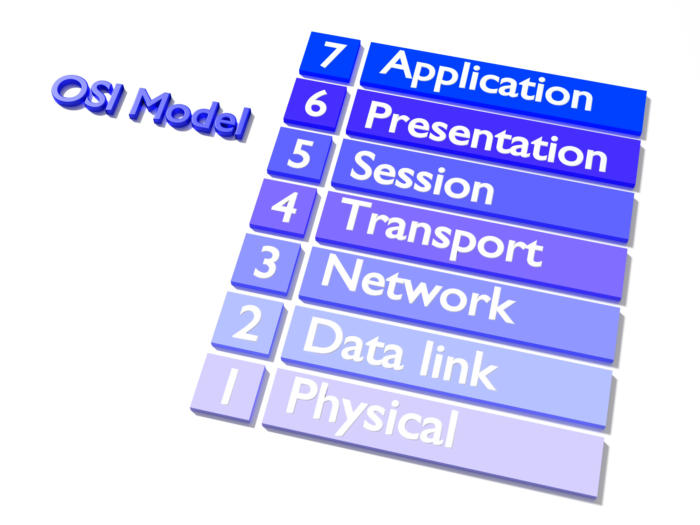
1-Application Layer It provides a real interface between the computer application and the network. This layer the one closest to the user. Only this layer does …
Continue readingThe task of each layer is to provide service to a higher (higher) layer. Two computers in the communication between the layers respectively; At the same time, …
Continue reading
OSI Model OSI (Open Systems Interconnection) model ISO (International Standards Organization) and the way I work between the two computers. First This standard, …
Continue readingMODUL 1: Network Basics • Basic knowledge. • To explain the layered model. • Describe the OSI reference model. • Describe the network specificity of the layers. …
Continue reading