Ubuntu

What is Ubuntu Cleaner? How to Install? (Ubuntu / Linux Mint)

What is Ubuntu Cleaner? How to Install? (Ubuntu / Linux Mint)

Fadıl

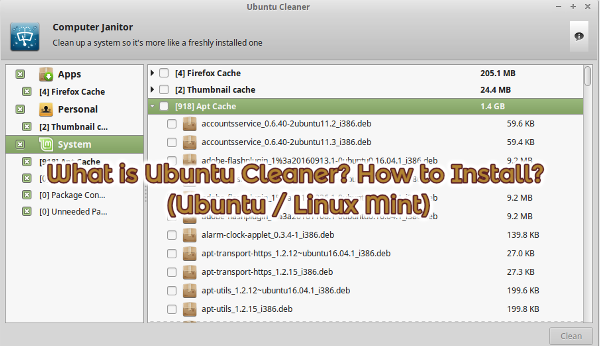
Ubuntu Cleaner is an open source software that removes old kernel files and unused packages on your computer with the remnants of the browser, thumbnails, and applications.

Warning: When you use this kind of software, you should be careful if you do not want to delete files on your computer.

Ubuntu Cleaner Installation (Ubuntu / Linux Mint)

If you want to install Ubuntu Cleaner from deb package, you can download it from here.

Stay in Ubuntu Login Screen

Stay in Ubuntu Login Screen

Fadıl

If you enter your password on the Ubuntu screen and you are likely to fall back to the password screen, your configuration file is damaged. This will be the first and fastest way to reset the config file, but as I always say, resetting without backup can hurt you as much as it can hurt your head.

On the basis of the process, simply follow these steps in order:

  • CTRL + ALT + F2                 (my preference is to use F1 if you want F2)
    

Log in to the drop-down terminal screen. Next step

How to Locking And Unlocking User Accounts in Linux?

Fadıl

There may come a time when you need to disable a users login to your Linux box… without deleting there account and still allowing them to receive the email. To do this you must login as “root” and at the command prompt type:

<root@techsoftcenter>:/#"passwd -l username"

(Without the quotes of course) This will lock the users account denying them access to login. You may be thinking “well how do I unlock it now?”, well there’s a command for that too =) At the command prompt type:

Filesystems, Directories and Devices NHF

Fadıl

Here are some explanations on file systems, directories, and devices between windows and Linux which people might not understand the terms and not migrate to Linux for some reason.

Coming to Linux from an OS like Windows requires you to learn not only how to operate, but how to understand what is going on in your computer. Many people have a good understanding of the underlying DOS directory structure and how it operates, so switching between OS’s such as mac-os, W8, and W10 are relatively seamless. However, Linux demonstrates a new way of thinking for many users.

How to Monitoring Your System?

How to Monitoring Your System?

Fadıl

An easy way to keep tabs on your system is through the program top. The top is a little app that can display the processes currently running, how much RAM, processor and how much CPU time they are taking (just like ps aux). First, let’s start off by starting it up.

[root@rd ~]# top

This should bring up a nice looking program that shows us much of what ps aux shows us but updated every second. You can change the time between updates by pressings, then typing in the seconds between updates (Note: you can use decimal numbers like 0.5). To switch to command mode display, hit c, and to sort by CPU time hit T.
The top is very useful in tracking what your resource hogs are, and what your RAM and Swap usage is. Play with it, the top’s a neat little program.